
Gangrene Treatment in Porbandar: How Feet Are Actually Saved
Published: 11 August 2026 · Last Updated: August 2026
Key Takeaways
- Gangrene means tissue has already died, so no ointment, antibiotic or home remedy can bring it back.
- Wet gangrene with fever, foul discharge and spreading redness is a surgical emergency that needs attention within hours.
- Removing dead tissue early usually preserves far more of the foot than waiting for the black area to settle.
- Blood supply testing guides everything, because a wound cannot heal inside a limb starved of circulation.
- Most limbs lost to diabetes are lost after preventable delay rather than after genuine surgical failure.
- Assessment, surgery and dressing planning can usually be completed within one organised visit to Surat.
Gangrene is tissue death, and it spreads faster than most families expect. Gangrene Treatment in Porbandar therefore begins with one urgent decision, namely whether dead tissue can be removed quickly enough to save the rest of the foot. Because delay remains the single biggest reason limbs are lost, the first few days matter far more than everything that follows.
Patients who travel to Dr. Ashutosh Shah from Saurashtra usually describe a familiar sequence. A blister or a thorn prick went unnoticed, one toe darkened over a week, and fever followed soon after. Although home dressings were tried sincerely, the black area kept creeping outward. Since diabetes dulls sensation, many people feel almost nothing while the damage advances underneath the skin.
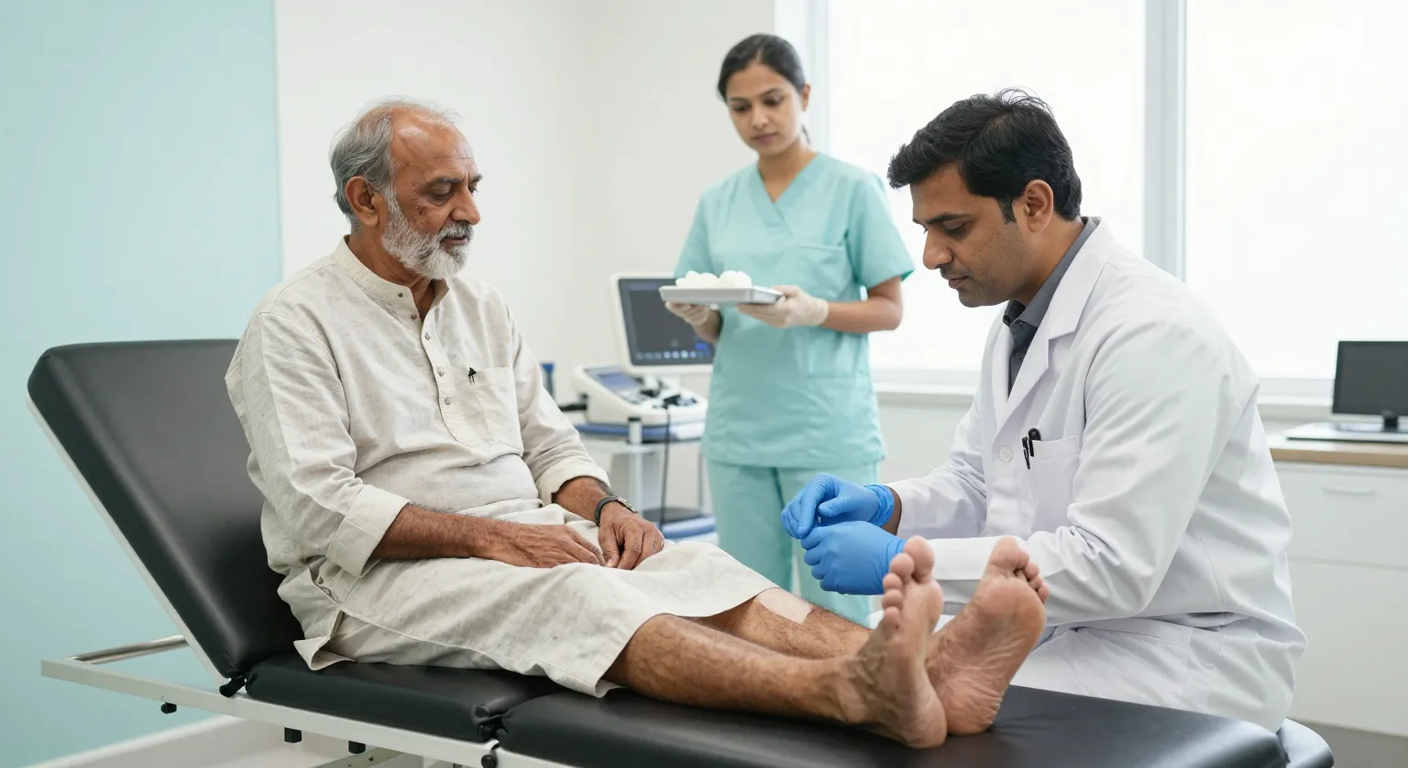
What is gangrene?
Gangrene develops when a section of tissue loses its blood supply or becomes overwhelmed by infection, after which the cells die and darken. Toes are affected most often, although the heel, forefoot and lower leg follow exactly the same pattern. Colour shifts from red to purple, then to grey or black.
Gangrene is the death of body tissue caused by loss of blood supply, severe infection, or both together, and dead tissue must be removed surgically because it cannot recover or heal on its own.
Two features separate gangrene from an ordinary wound. Firstly, the dead area carries no sensation of its own, which falsely reassures patients into waiting. Secondly, bacteria multiply happily inside dead tissue where antibiotics penetrate poorly, therefore medicines alone rarely bring the situation under control.
What causes gangrene in the foot?
Diabetes causes most foot gangrene seen across Saurashtra, usually by combining nerve damage with narrowed arteries. Injuries go unfelt, small wounds turn septic, and weak circulation prevents healing. Smoking, peripheral artery disease, kidney failure and untreated cellulitis add further risk, while pressure from tight footwear frequently triggers the very first breakdown.
The World Health Organization identifies diabetes as a leading cause of lower limb amputation worldwide, and foot ulcers precede the majority of those amputations. That sequence is entirely interruptible. When an ulcer is treated properly before tissue dies, the story usually ends with a healed foot rather than an operation theatre.
Fishing and farming communities around Porbandar face an added hazard. Wet footwear, sea water exposure and long barefoot hours allow minor cuts to become infected quickly, especially when sugar levels have been high for months.
How do wet and dry gangrene differ?
Dry gangrene develops slowly from poor circulation, stays firm and dark, and produces little discharge or odour. Wet gangrene involves active infection, therefore it swells, smells foul, oozes pus and spreads rapidly. Dry gangrene often allows planned surgery, whereas wet gangrene demands emergency drainage because infection can enter the bloodstream within hours.
Gas gangrene forms a third and rarer category, producing crackling under the skin and deteriorating extremely fast. Any patient with fever, confusion, vomiting or a rapidly rising black area belongs in a hospital immediately, not in a queue for an outpatient appointment.
Which warning signs need same day attention?
Black or blue discolouration, foul smell, pus, spreading redness above the ankle, sudden swelling, fever above one hundred degrees, or a wound that worsens visibly within twenty four hours all demand same day review. Vomiting, drowsiness or uncontrolled sugar readings alongside any of these signs suggest infection has already spread beyond the foot.
- Skin turning dark around a wound edge, particularly when the area also feels cold.
- Discharge that soaks a dressing within hours, especially when the odour becomes noticeable across a room.
- Red streaks travelling up the leg, which indicate infection moving through the lymphatic channels.
- Sugar readings that suddenly refuse to settle despite unchanged medication and diet.
Treatment options that genuinely save limbs
- Urgent debridement: dead and infected tissue is removed surgically, which halts the spread and converts a septic wound into a clean one.
- Circulation assessment: Doppler studies and angiography reveal blocked arteries, since healing simply cannot occur without adequate blood flow reaching the wound.
- Revascularisation: angioplasty or bypass restores flow to a starved foot, thereby turning an unsalvageable limb into a salvageable one.
- Targeted antibiotics: culture guided medicines control the infection, though they support surgery rather than replace it.
- Negative pressure dressings: vacuum therapy draws out fluid, reduces swelling and encourages healthy tissue to fill the defect faster.
- Reconstruction: skin grafts or flaps close the resulting wound, which allows patients to walk again rather than live with an open defect.
- Limited amputation: removing one toe or a small segment early is frequently what prevents losing the entire leg later.
How Gangrene Treatment in Porbandar Cases Is Planned
- Emergency stabilisation: sugar levels, hydration and sepsis markers are corrected first, because operating on an unstable patient increases every risk involved.
- Wound and blood flow mapping: the dead margin is defined clinically while Doppler testing measures circulation in the leg arteries.
- Source control surgery: all dead and infected tissue is excised, pus pockets are drained, and deep samples go for culture.
- Restoring circulation: vascular intervention is arranged when arteries are blocked, since further reconstruction would otherwise fail.
- Wound bed preparation: repeat dressings or vacuum therapy build clean granulation tissue over the following two to three weeks.
- Definitive cover: a graft or flap closes the wound, after which walking is restarted gradually with pressure relieving footwear.
Should Porbandar patients travel to Surat for this?
Travel makes sense when a wound has stopped improving, when black tissue keeps advancing despite dressings, or when amputation has already been advised elsewhere. Surat lies roughly four hundred and eighty kilometres away by road, therefore most families plan one properly organised visit rather than repeated short trips.
Elegance Clinic runs consultations at Adajan and Vesu only, so there is no branch or visiting camp in Porbandar, and no honest surgeon would claim otherwise. Local physicians handle early ulcers and routine dressings perfectly well. Specialist referral becomes worthwhile once tissue has died, bone appears exposed, or reconstruction is needed to close the defect.
Practical arrangements matter as much as surgery itself. The outstation patient guide explains investigation planning before arrival, accommodation near the clinic, and video follow ups once patients return home to Saurashtra.
What does the treatment cost?
Cost depends on how much tissue has died, whether vascular intervention is required, how many dressing sessions follow, and whether reconstruction is needed at the end. A single toe debridement sits at the lower end, whereas a major salvage involving angioplasty, repeat surgery and a flap costs considerably more.
Written estimates follow examination and investigations rather than a phone conversation, because guessing without seeing the wound helps nobody. Many admissions of this type attract partial insurance coverage, since the treatment is medically necessary rather than cosmetic. Instalment options are explained in the EMI and financing guide for families managing costs across several months.
Healing, results and honest timelines
Healing takes longer than patients hope, mainly because diabetic tissue repairs slowly. Small wounds close within four to six weeks, whereas larger defects needing grafts often take two to three months before walking becomes comfortable again. Sugar control influences that timeline more powerfully than any dressing material.
Examples of salvaged feet and healed graft sites appear in the before and after gallery. Realistic expectations help enormously here. Saving a functional foot, even one missing a toe, is a far better outcome than a below knee amputation that changes mobility permanently.
Myths that cost people their feet
- Black tissue does not recover with better dressings, since dead tissue has no blood supply left to heal with.
- Antibiotics alone will not clear gangrene, because medicines cannot penetrate tissue that no longer has circulation.
- Waiting for the area to fall off naturally allows infection to travel deeper into bone and bloodstream.
- Removing one toe does not automatically lead to further amputations, and it frequently prevents them.
- Herbal pastes and oils applied to open wounds regularly introduce fresh infection rather than curing anything.
- Painless does not mean harmless, given that nerve damage removes pain precisely when it would have been useful.
Aftercare that protects the limb
Offloading protects healing more than anything else, therefore prescribed footwear, casts or crutches must be used exactly as advised. Keep dressings dry, attend review appointments even when the wound looks settled, and inspect both feet daily using a mirror for the sole. Family members often spot changes earlier than patients do.
Sugar discipline continues long after discharge. Aim for the targets agreed with your physician, stop smoking completely because nicotine narrows the very arteries feeding the wound, and never walk barefoot indoors or outdoors. Any new blister, crack or colour change deserves review within days rather than weeks.
Why patients choose Elegance Clinic
Families arriving from Saurashtra usually want two things, namely a straight answer and a plan they can afford. Elegance Clinic works through plastic surgical reconstruction rather than routine dressings alone, which matters when a wound needs a graft or flap to close properly. Dr. Ashutosh Shah brings more than twenty two years of reconstructive experience to that judgement.
Anyone considering Gangrene Treatment in Porbandar should ask one question before accepting an amputation anywhere. Ask whether blood flow to the limb has been formally tested, because a foot declared unsalvageable without that test may simply be a foot with a correctable blockage. Second opinions can be arranged through the clinic contact page, and appointment slots through online consultation booking.
FAQs
Can gangrene be cured without surgery?
Dead tissue cannot be revived by any medicine, so surgical removal remains essential in almost every case. Antibiotics control the surrounding infection and improve safety, yet they work as support for surgery rather than as a replacement for it.
How quickly does gangrene spread?
Wet gangrene can advance within hours, particularly when sugar levels are high and infection has reached deeper tissue planes. Dry gangrene progresses far more slowly over weeks, although it still requires assessment because the underlying circulation problem continues worsening.
Does gangrene always mean amputation?
Amputation is not automatic, and many limbs are saved when patients present early enough. Removing a small dead segment, restoring blood flow and closing the wound with a graft frequently preserves a functional foot for walking.
Is the surgery painful for diabetic patients?
Nerve damage means many patients feel remarkably little in the affected area itself. Anaesthesia covers the procedure completely, while prescribed medication manages the surrounding soreness afterwards, which most people describe as mild rather than severe.
How long does the wound take to heal afterwards?
Small wounds usually close within four to six weeks with regular dressings. Larger defects requiring skin grafts take two to three months, and healing speed depends heavily on blood sugar control, nutrition and consistent offloading of the foot.
Will health insurance cover this treatment?
Coverage is common because gangrene treatment is medically necessary rather than cosmetic. Policies differ in waiting periods and room limits, therefore checking terms and obtaining preauthorisation before admission avoids unpleasant surprises during the discharge process.
Can gangrene return after successful treatment?
Recurrence is possible whenever the underlying causes persist, especially uncontrolled diabetes, continued smoking or untreated artery narrowing. Regular foot checks, protective footwear and prompt attention to any new wound reduce that risk substantially over the years ahead.
Ready to discuss your concern in person? Book a private consultation at our Adajan or Vesu clinic. Call +91 83205 00350 or use the Book Consultation button.